Enterprise AI context
Why Enterprise AI Needs Context, Not Just More Data
Enterprise AI is only as useful as the information it can access.
Enterprise AI is only as useful as the information it can access.
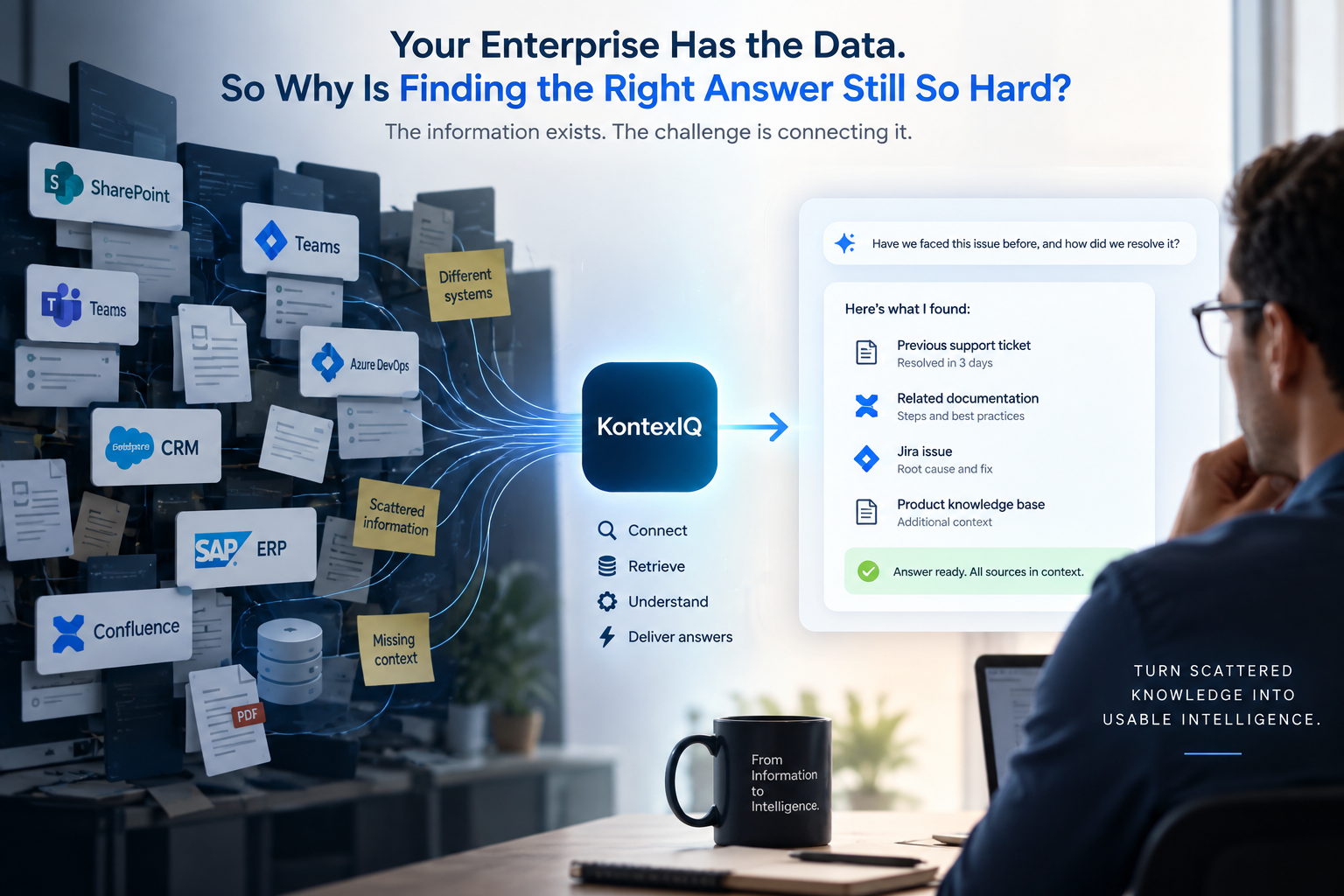
Most organizations already have the data they need. It exists across documents, databases, support tickets, CRM systems, internal applications, Jira, Azure DevOps, and the knowledge held by experienced employees.
Yet when someone needs an answer, finding all the supporting details can be surprisingly difficult.
Your enterprise probably does not have a data problem.
It has a context problem.
The information exists, but it is scattered across systems, records, teams, and conversations. Employees must search for it, determine what is relevant, compare different sources, and connect the findings themselves.
The challenge is not finding more data. It is making existing knowledge useful.
Enterprise Information Is Everywhere. Understanding Is Not.
Consider a question that teams ask every day:
Have we faced this issue before, and how did we resolve it?
The answer may not exist in one document or system.
Part of it may be recorded in a support ticket. Another detail may appear in a Jira issue. The technical explanation may be buried in product documentation, while the final resolution exists in a comment added during an earlier release.
Even after finding those records, someone still needs to determine:
- Which information is current?
- Which records describe the same issue?
- What caused the problem?
- What solution was implemented?
- Did that solution introduce any additional risks?
- Is the earlier resolution relevant to the current situation?
This is why traditional search often falls short.
Search finds information. Context turns it into an answer.
What This Problem Looks Like in Software Delivery
Imagine that a QA lead receives a new Jira user story:
As a customer, I want to update my payment method before my next billing date so that future payments use the new card.
At first, the requirement appears straightforward. The user needs to add or select a different payment method, and the system needs to use it for the next payment.
But as the QA lead reviews the story, several questions emerge:
- What happens if the current payment has already failed?
- Can a customer change the payment method while an invoice is being processed?
- What happens when the new card is expired or declined?
- Does the change apply to pending invoices or only future invoices?
- Are recurring subscriptions and one-time payments handled differently?
- What happens if two payment updates occur at nearly the same time?
- Are there dependencies on the billing service or payment provider?
- Has a similar change caused defects in an earlier release?
The answers may already exist. However, they are unlikely to be contained in the user story itself.
The Daily Search Across Systems and People
To understand whether the requirement is ready, the QA lead begins gathering information.
First, they search Jira for similar user stories and previously reported defects. They find several results, but the titles are not specific enough to confirm which ones are relevant.
Next, they review old test cases to see whether payment-method changes have been tested before. Some test cases are current, while others were created before the latest billing-service update.
They then check previous release notes and delivery records. A similar feature was released several months ago, but the details are spread across multiple work items and comments.
A customer-facing issue may also have been reported through the support team. The QA lead contacts someone in customer support to ask whether users have experienced problems when updating cards during an active billing cycle.
The product owner is asked to clarify whether pending invoices should use the old or new payment method. A developer is contacted to confirm whether changing a stored payment token affects other services. Another QA engineer remembers a related production defect but cannot immediately recall the issue number.
Eventually, the team may assemble enough information to proceed.
But doing so requires:
- Searching across multiple systems
- Opening and reading several records
- Comparing current and historical information
- Contacting people from different teams
- Waiting for responses
- Determining which details are still valid
- Manually connecting requirements, defects, tests, and dependencies
None of this work is unusual. It happens every day across software teams.
The problem is not that the organization lacks knowledge. The problem is that the right information is difficult to bring together at the moment a decision needs to be made.
What Happens When Important Information Stays Disconnected?
When teams cannot find and connect relevant information early, important gaps often remain hidden until development or testing begins.
A missing business rule becomes a late clarification.
An overlooked dependency causes unexpected rework.
A previously resolved defect returns because nobody connected it to the new requirement.
Test coverage focuses on the expected user journey while high-risk scenarios remain untested.
Developers pause implementation while waiting for answers. QA teams spend more time investigating than testing. Product owners receive clarification requests after development has already started.
Each individual issue may appear small, but together they can lead to:
- Incomplete or ambiguous requirements
- Longer development and testing cycles
- Repeated defects
- Missed edge cases
- Unplanned rework
- Delayed releases
- Lower confidence in release decisions
The earlier these gaps are identified, the easier and less expensive they are to address.
Why Enterprise AI Needs Connected Information
Adding an AI model to enterprise data does not automatically solve this problem.
Enterprise knowledge is distributed across different systems, stored in different formats, updated at different times, and governed by different access controls. Some sources may be incomplete, outdated, or contradictory.
To provide a useful response, AI must retrieve the right information, recognize relationships between records, respect access permissions, and show the evidence supporting its output.
This is what makes enterprise AI context important.
It enables an AI system to move beyond isolated documents and use the business information most relevant to a specific requirement, question, risk, or decision.
The objective is not simply to make search faster.
It is to turn enterprise knowledge into practical intelligence that teams can use in their daily work.
How KontexIQ Changes the Requirement-Review Process
Now consider the same payment-method requirement with KontexIQ.
Instead of reviewing the user story in isolation, the QA and engineering teams can evaluate it alongside related requirements, defects, test cases, dependencies, and delivery history from Jira or Azure DevOps.
KontexIQ can help identify that the story does not explain:
- How pending invoices should be handled
- What should happen after a failed payment
- Whether the change affects active subscriptions
- How concurrent payment updates should be managed
- Which external services or components are involved
It can also bring relevant historical information into the review.
For example, an earlier defect may show that payment updates failed when a transaction was already in progress. A previous test case may reveal that expired cards were tested, but concurrent updates were not. Delivery history may indicate that changes to the billing service have previously affected subscription renewals.
These supporting details help the team understand the requirement more completely before development begins.
From an Isolated User Story to an Informed Decision
KontexIQ does more than identify missing information. It helps teams determine what to do next.
Based on the requirement and the available project knowledge, it can generate practical test scenarios such as:
- Updating a valid card before the next billing date
- Attempting to add an expired or declined card
- Updating a payment method after a payment has failed
- Changing a card while an invoice is being processed
- Performing two payment updates at nearly the same time
- Verifying whether pending and future invoices use the correct payment method
- Checking the impact on active subscriptions and related billing services
KontexIQ can then recommend an appropriate testing path for each scenario:
- Manual testing when human judgment or exploratory validation is important
- Automation when the scenario is stable, repeatable, and suitable for ongoing regression coverage
- Hybrid testing when automated checks should be combined with manual verification
- Investigate when additional information is required before testing can be planned
- Blocked when an unresolved dependency or missing decision prevents progress
- Skip when testing is unnecessary or provides limited value for the specific change
Each recommendation can include rationale, confidence, and supporting evidence.
The team is no longer starting with an isolated ticket. It is starting with a clearer view of the requirement, its risks, its dependencies, and the testing effort it may require.
What This Means for Software Teams
Connected delivery knowledge benefits every team involved in the software lifecycle.
For QA teams
QA leads can identify missing acceptance criteria, overlooked edge cases, and testing risks earlier. They spend less time searching for historical information and more time designing meaningful test coverage.
For engineering teams
Developers receive clearer requirements and fewer unexpected clarification requests during implementation. Dependencies and technical risks can be identified before they cause rework.
For product teams
Product owners can address ambiguity before development begins. They receive focused questions based on relevant project information rather than broad requests for clarification.
For delivery leaders
Delivery managers and release managers gain a clearer view of readiness, unresolved risks, and testing decisions. This supports more informed release planning and greater confidence in delivery outcomes.
Turning Enterprise Knowledge Into Software Delivery Intelligence
KontexIQ does not replace Jira, Azure DevOps, or the systems your teams already use.
It helps the information within those systems work together.
By connecting requirements, bugs, tests, dependencies, and delivery history, KontexIQ helps teams:
- Review requirements and user stories before development
- Identify ambiguity, assumptions, dependencies, and edge cases
- Detect missing or incomplete acceptance criteria
- Generate practical test scenarios
- Recommend risk-based testing paths
- Provide rationale, confidence, and evidence
- Improve QA readiness and release confidence
Your enterprise already has valuable knowledge.
The opportunity is to bring the right information together and use it before important decisions are made.
Frequently Asked Questions
What is enterprise AI context?
Enterprise AI context is the relevant organizational information an AI system uses to answer a question or support a workflow. It may include documents, requirements, support tickets, defects, test cases, customer records, engineering decisions, dependencies, and delivery history.
Why is connected enterprise knowledge important?
A single document or record rarely contains everything needed to answer a complex business question. Connected enterprise knowledge reveals relationships across systems and gives employees and AI applications a more complete understanding of the issue.
How does intelligent knowledge retrieval improve enterprise AI?
Intelligent knowledge retrieval gives an AI system access to relevant information from approved enterprise sources before it generates a response. This can make answers more specific, current, traceable, and useful to the organization.
What is the difference between enterprise search and context-aware AI?
Enterprise search helps users locate documents and records. Context-aware AI goes further by retrieving, connecting, and synthesizing relevant information into an answer grounded in enterprise sources.
How does KontexIQ help with requirement reviews?
KontexIQ evaluates requirements and user stories alongside related project information. It helps teams identify ambiguity, missing acceptance criteria, assumptions, dependencies, edge cases, and delivery risks before development begins.
How does KontexIQ support software testing decisions?
KontexIQ generates practical test scenarios and recommends risk-based testing paths, including manual, automation, hybrid, investigate, blocked, or skip. It also provides rationale, confidence, and supporting evidence for its recommendations.
Turn Scattered Delivery Knowledge Into Confident Decisions
Your teams already have the information they need. KontexIQ helps them connect it, understand what matters, and apply it more effectively.