Tribal knowledge in software teams
Your Team Already Knows the Answer. The Problem Is Finding Who Knows It.
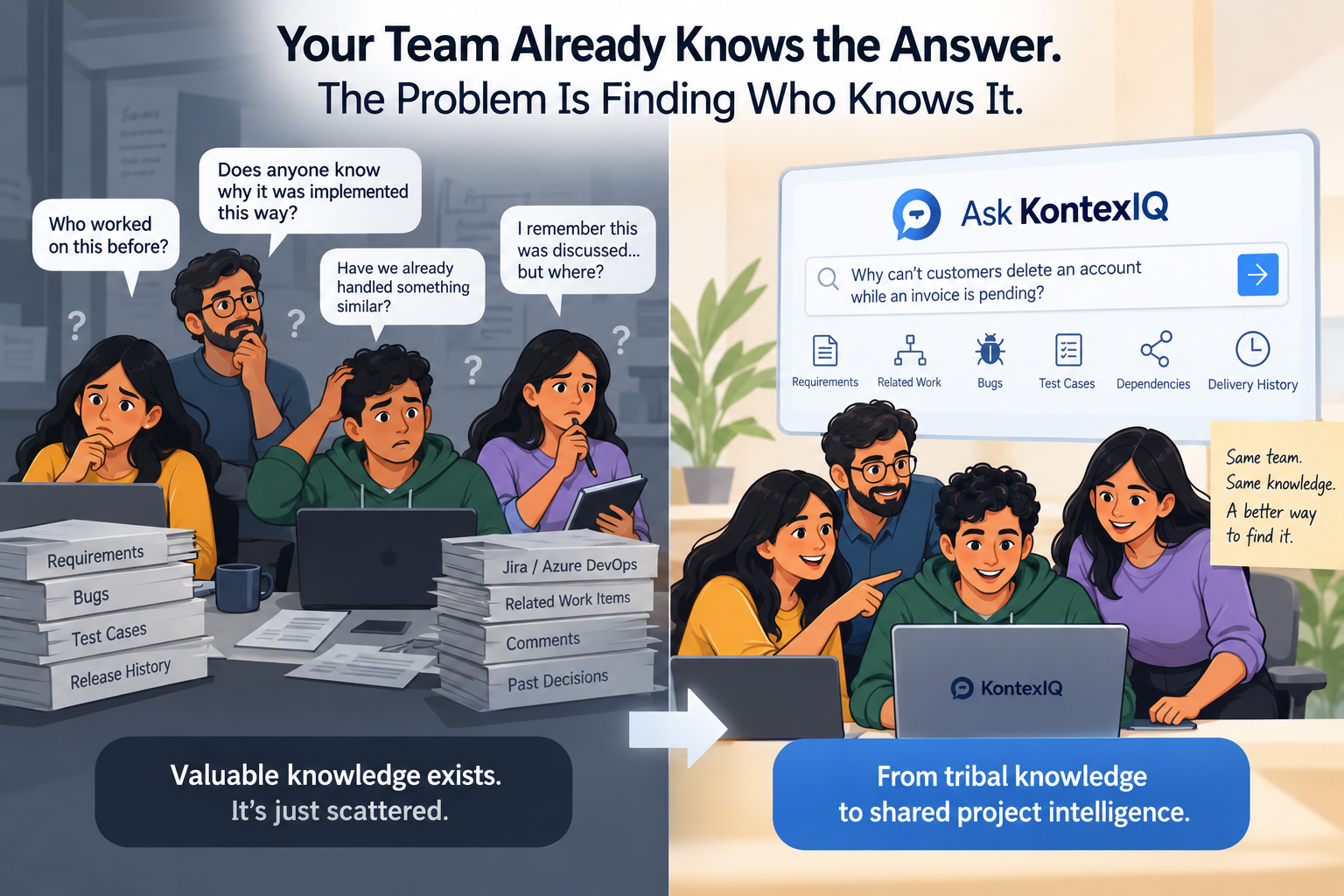
Who worked on this before?
Does anyone know why it was implemented this way?
Have we already handled something similar?
These questions are familiar in software teams.
A developer gets stuck on a requirement and asks a senior engineer. A QA engineer finds unexpected behaviour and checks with the business analyst. A product manager remembers that a similar decision was discussed months ago—but cannot remember where it was recorded.
Usually, someone knows the answer.
The problem is finding who.
This is how tribal knowledge in software teams develops: important product history becomes accessible mainly through the people who remember it.
When Project Knowledge Lives With People
As a software product grows, its history grows with it.
Requirements change. Technical decisions are made. Bugs reveal unexpected behaviour. Test scenarios evolve. Business rules are clarified. Teams learn from earlier releases.
But those lessons do not always remain connected.
Some are recorded in Jira or Azure DevOps. Others are buried in comments, related work items, test cases, defects, or release history. Certain details may remain only with the people who participated in the original discussion.
This creates tribal knowledge—valuable project understanding that depends heavily on individual memory.
That approach works until the person who remembers the decision is unavailable, changes projects, or leaves the organization.
A Simple Question Can Require a Long Search
Imagine that a developer discovers that customers cannot delete an account while an invoice is pending.
The current requirement does not explain why. There is no obvious note in the user story, and the behaviour looks like an unnecessary restriction.
To understand it, the developer may need to:
- Find out who originally worked on account deletion
- Contact a senior engineer
- Search for related Jira or Azure DevOps work items
- Review an older billing defect
- Check whether QA has a relevant test case
- Ask the product owner whether the restriction still applies
Eventually, the team discovers that the rule was introduced after an earlier release caused financial records to become disconnected from deleted accounts.
The answer existed. It was simply distributed across a requirement, a defect, a test, and the memories of the people involved.
The Hidden Cost of Asking Around
Teams should talk to one another. Collaboration is not the problem.
The problem begins when asking around becomes the default way to recover project history.
A simple question can turn into:
Find the right person → wait for a response → explain the issue → search for an old record → reconstruct the answer
Repeated across an engineering organization, these small searches create frequent interruptions.
Experienced team members become unofficial project directories. Their time is repeatedly used to answer questions they may have explained before.
Other employees wait for replies before they can continue. Decisions take longer, and important details can change as they pass from one person to another.
New team members face an additional challenge. Before they can understand the product, they must first learn the organization’s network of people who know particular areas.
Over time, this can lead to:
- Repeated investigations
- Decisions made without historical evidence
- Previously resolved defects returning
- Important dependencies being overlooked
- Longer onboarding periods
- Greater reliance on a small number of experienced employees
The team has already created the knowledge. Accessing it should not depend on rediscovering who remembers it.
What If the Project Could Answer?
This is the idea behind Ask KontexIQ.
Instead of beginning with:
Who knows the answer?
the team can begin with:
What does the project already tell us?
KontexIQ helps teams ask questions using the delivery records surrounding their work.
Depending on what is available in the project, these records may include:
- Requirements and acceptance criteria
- Related work items
- Bugs and previous resolutions
- Existing test scenarios
- Dependencies
- Earlier decisions
- Delivery history
For the account-deletion question, the team could examine the earlier billing defect, understand why the restriction was introduced, and review the tests that protect the expected behaviour.
The first step no longer needs to be interrupting the person who might remember.
It can be asking KontexIQ what the project already knows.
Making Team Experience Easier to Reuse
KontexIQ does not replace experienced team members.
Their judgment remains essential when evidence is incomplete, records disagree, or a new decision must be made.
The difference is that those individuals do not need to remain the only route to information that already exists elsewhere.
A developer should not always need to identify the original engineer.
A QA professional should not have to reconstruct the history behind every requirement.
A new employee should not need to understand the entire network of “people who know things” before finding a useful answer.
When previous work becomes easier to access, experienced employees spend less time repeating history and more time applying their expertise to new decisions.
From Tribal Knowledge to Shared Project Intelligence
Software teams will always depend on human experience. The goal is not to remove that experience from delivery work.
The goal is to prevent valuable understanding from remaining locked inside individual memory.
When requirements, defects, tests, dependencies, and earlier decisions can be examined together, teams gain a more reliable starting point for their questions.
Because in many software projects, the answer is already there.
The team simply needs a better way to find and reuse it.
Frequently Asked Questions
What is tribal knowledge in software teams?
Tribal knowledge is project understanding that depends mainly on individual team members remembering previous requirements, decisions, defects, or technical choices. Some of it may be documented, but other employees may not know where to find it.
Why is tribal knowledge a risk for software delivery?
When critical knowledge depends on particular people, teams can experience delays, repeated investigations, inconsistent decisions, longer onboarding, and overlooked dependencies. The risk increases when experienced employees are unavailable or leave the organization.
How can software teams reduce their reliance on tribal knowledge?
Teams can document important decisions, connect related requirements and defects, maintain current test cases, and preserve the reasoning behind product behaviour. They also need an effective way to retrieve these records when questions arise.
How does Ask KontexIQ help teams find project knowledge?
Ask KontexIQ helps teams explore relevant records across requirements, acceptance criteria, work items, bugs, test scenarios, dependencies, and delivery history. It provides a project-informed starting point before employees search manually or interrupt an experienced colleague.
Does Ask KontexIQ replace experienced team members?
No. Experienced professionals still provide judgment, clarification, and decision-making when evidence is incomplete or a new situation arises. Ask KontexIQ makes existing project knowledge easier to access so people do not have to repeatedly reconstruct the same history.
Stop Searching for Who Might Know
Your project may already contain the answer. KontexIQ helps your team find and reuse it.
Ask KontexIQ using the knowledge your project already contains.