Conversational requirement analysis
Don’t Just Write User Stories. Have a Conversation With Them.
A user story can be written, reviewed, and still leave important questions unanswered.
In our previous article, we explored how analyzing a user story against existing project knowledge can uncover gaps that aren't obvious from the story alone.
But finding those gaps is only the beginning.
What happens after the questions appear?
You answer them. Those answers may reveal new questions. Assumptions get challenged. Missing details become clearer. The requirement gets refined.
And the conversation continues.
That is where conversational analysis changes the way teams work with requirements.
Story Analysis Shouldn't End With a List of Questions
Consider a simple requirement:
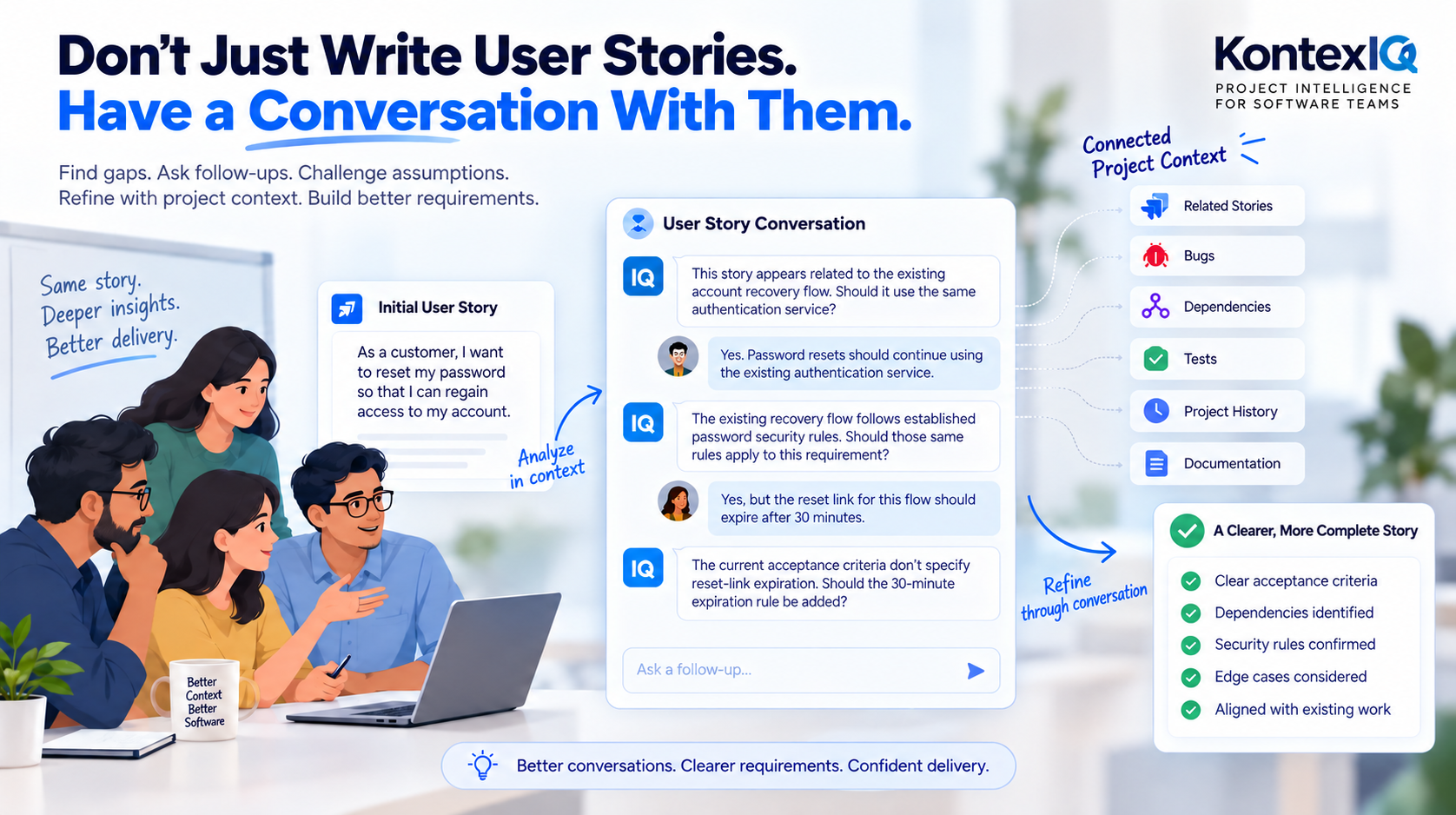
“As a customer, I want to reset my password so that I can regain access to my account.”
The acceptance criteria might cover the basic flow:
- Generate a reset link
- Allow the customer to create a new password
- Confirm the successful reset
At first glance, the story looks reasonably complete.
But when it is analyzed against existing project knowledge, other questions may surface:
- Is there already an account recovery flow?
- What happens when the reset link expires?
- Are there existing password policies?
- Which service handles authentication?
- Are there known issues related to this flow?
Identifying these gaps is valuable.
But a list of questions doesn't make the requirement clearer by itself.
The team still needs to work through them.
The Most Useful Question May Come After the First Answer
Suppose the analysis identifies a connection to an existing account recovery flow.
The conversation might begin like this:
KontexIQ: This story appears related to the existing account recovery flow. Should it use the same authentication service?
Team: Yes. Password resets should continue using the existing authentication service.
That resolves one question.
But the answer creates another:
KontexIQ: The existing recovery flow follows established password security rules. Should those same rules apply to this requirement?
Team: Yes, but the reset link for this flow should expire after 30 minutes.
Now another important detail has appeared.
KontexIQ: The current acceptance criteria don't specify reset-link expiration. Should the 30-minute expiration rule be added?
What started as one question has helped uncover a requirement detail that wasn't present in the original story.
This is how requirements often mature in real projects.
One answer creates clarity—but it can also reveal the next question worth asking.
From One-Time Analysis to an Ongoing Conversation
A common AI workflow looks something like this:
Analyze → Receive questions → Done
That can be useful, but it treats analysis as an output rather than a process.
Requirement analysis rarely works that way in practice.
Teams discuss. They clarify. They discover dependencies. They revisit assumptions. They update the requirement as their understanding improves.
A more useful workflow looks like:
Analyze → Question → Respond → Explore → Refine → Validate
In that process, AI can help the team:
- Identify ambiguities
- Surface missing scenarios
- Highlight dependencies
- Challenge assumptions
- Connect the story with related project work
- Explore the implications of an answer
- Validate refinements against existing project knowledge
The objective isn't to generate as many questions as possible.
It's to help the team work through the questions that actually matter.
Why Project Knowledge Changes the Conversation
Conversational analysis becomes significantly more useful when the AI understands more than the text of the current user story.
Relevant information may already exist across:
- Related user stories
- Acceptance criteria
- Bugs
- Dependencies
- Tests
- Previous implementations
- Project history
Without that surrounding information, an AI might ask:
“Are there any dependencies?”
That's a reasonable question, but it still leaves the team to find the answer.
With project-level knowledge, the conversation can become more specific:
“This story appears to depend on the authentication service used by the existing account recovery flow. Should the same implementation and security rules apply here?”
Now the question isn't simply asking whether a dependency exists. It is pointing the team toward a relevant connection and asking them to validate it.
That's an important distinction.
Generic questions come from the requirement.
Relevant questions come from the requirement + project knowledge.
And when the team's answers become part of an ongoing conversation, those questions can become progressively more useful.
Requirement Maturity Is a Process, Not a Score
There is another important point.
The purpose of conversational analysis isn't for AI to declare:
“This story is ready.”
Requirement readiness depends on the team, the project, the type of work, the associated risk, and many other factors.
Instead, AI can help teams understand what may still need attention before they decide to move forward.
For one requirement, that might be an unresolved dependency.
For another, it could be unclear business behavior.
For another, it might be a missing edge case that affects testing.
The value isn't in giving the requirement an arbitrary maturity score.
The value is in helping the team reduce uncertainty around the work.
Where KontexIQ Fits
This builds directly on the workflow we've explored throughout this series.
First, project knowledge becomes accessible through conversation.
Then, that knowledge can be used to analyze user stories and uncover requirement gaps.
But the analysis doesn't have to end with the initial findings.
With KontexIQ, teams can continue exploring a requirement conversationally—working through missing information, questioning assumptions, referring to relevant project knowledge, and refining the story as new details emerge.
Instead of treating the first analysis as the final output, the conversation becomes part of the requirement-maturing process.
A BA or Product Owner can clarify business intent.
A developer can investigate dependencies or implementation assumptions.
QA can raise scenarios and edge cases that may affect validation.
And those perspectives can contribute to a clearer understanding of the same requirement before work progresses further.
The goal isn't for KontexIQ to make the team's decisions.
It's to help the team have a better-informed conversation before those decisions are made.
Don't Stop at “Analyze”
A requirement doesn't become mature simply because AI has reviewed it once.
It becomes stronger through iteration:
Find the gap.
Understand the surrounding project knowledge.
Ask the next relevant question.
Respond.
Explore what that answer changes.
Refine the requirement.
Validate again.
That is the difference between simply reviewing a requirement and having a conversation with it.
Because sometimes, the most valuable question isn't the first question AI asks.
It's the question that comes after your answer.
Frequently Asked Questions
1. What is conversational requirement analysis?
Conversational requirement analysis is an iterative approach where AI and the team continue exploring a requirement rather than treating analysis as a one-time activity. Questions, answers, project knowledge, and refinements build on one another as the team's understanding of the requirement improves.
2. How is conversational analysis different from regular user story analysis?
Traditional user story analysis may identify gaps, ambiguities, dependencies, or missing scenarios and return them as a list. Conversational analysis goes further by allowing the team to work through those findings, provide additional information, explore follow-up questions, refine the requirement, and validate the changes.
3. Why does project knowledge matter in user story analysis?
Important information often exists outside the current user story. Related requirements, bugs, dependencies, tests, previous implementations, and project history can all affect how a requirement should be understood. Connecting this information can make AI-generated questions more specific and relevant to the actual project.
4. Does conversational requirement analysis replace BAs, Product Owners, developers, or QA teams?
No. The team remains responsible for decisions, clarification, and validation. Conversational analysis is intended to help surface relevant questions and project information so people can make better-informed decisions.
5. When is a user story mature enough to move forward?
There is no universal definition. A story becomes more mature as the team gains sufficient clarity around its intent, expected behavior, assumptions, dependencies, risks, and relevant edge cases. The team ultimately determines when it has enough information to proceed.