AI test scenario generation
Your Team Already Understands the Requirement. Why Should QA Start Over?
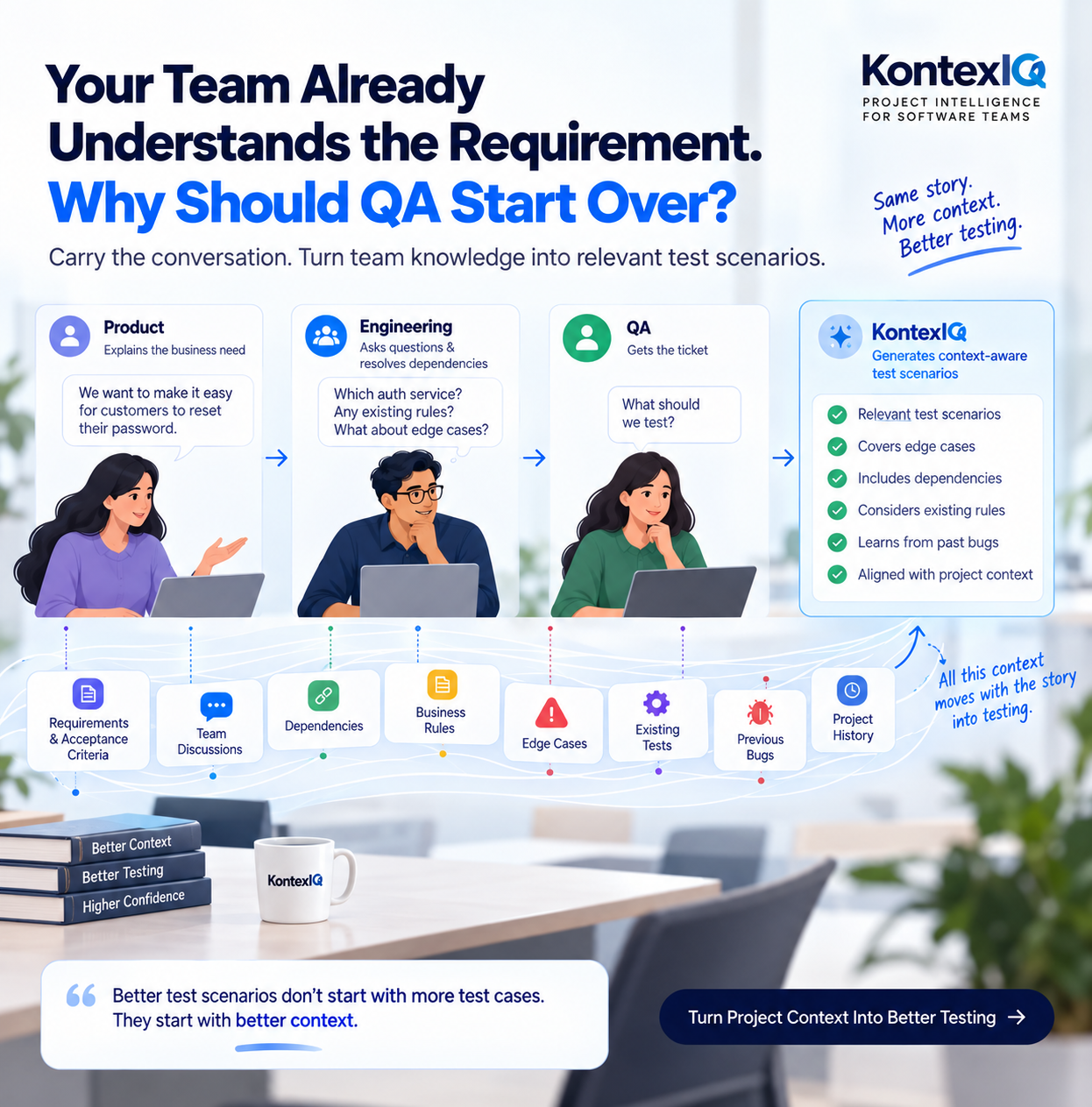
By the time a user story reaches QA, a lot has already happened.
The Product Owner has explained the business need. The BA has clarified the requirement. Developers have asked questions. Dependencies have been discussed. Assumptions have been challenged. Edge cases have surfaced.
And, as we explored in the previous article, the requirement may have gone through an ongoing conversation to become clearer as the team's understanding evolved.
Then the story reaches QA.
QA opens the ticket and asks:
What should we test?
But if the team has already learned so much about the requirement, why should QA have to start over?
The Story Doesn't Contain Everything the Team Learned
Consider the same requirement from our previous article:
As a customer, I want to reset my password so that I can regain access to my account.
The acceptance criteria might cover:
- Generate a reset link
- Allow the customer to create a new password
- Confirm the successful reset
But during analysis and refinement, the team may have already discovered that:
- The existing authentication service handles the reset flow
- Reset links should expire after 30 minutes
- Existing password security rules apply
- Multiple reset requests need to be handled
- A previous bug involved expired reset links
- The functionality interacts with an existing account recovery process
Those details are now part of the team's understanding of the requirement.
But if QA starts only with the final ticket, some of that understanding can get lost in the handoff.
The ticket is the handoff. It shouldn't be the starting point.
What Changes When QA Starts With Context?
QA doesn't test only what is written in the acceptance criteria.
Testing also considers existing behavior, dependencies, known issues, business rules, and edge cases.
That becomes easier to see when we compare the same requirement with and without the surrounding project knowledge.
From the story alone
QA might begin with scenarios such as:
- Verify that a customer can successfully reset a password
- Verify that an invalid password is rejected
- Verify that the reset link allows the customer to create a new password
- Verify that confirmation is shown after a successful reset
These are reasonable scenarios.
But they don't reflect everything the team already knows.
From the story + project understanding
The starting scenarios could also include:
- Verify that the reset link expires after 30 minutes
- Verify that an expired reset link cannot be reused
- Validate the new password against existing security rules
- Verify behavior when multiple reset requests are made
- Validate integration with the existing authentication service
- Check interaction with the existing account recovery flow
- Revisit the behavior associated with the previous expired-link defect
The requirement hasn't completely changed.
The starting point for testing has.
The second set reflects knowledge the team already uncovered through requirement analysis, previous defects, dependencies, existing behavior, and refinement conversations.
That's the difference between generating scenarios from the story and generating scenarios from the story in context.
Carry the Understanding Forward
This is the next step in the workflow we've been building throughout this series.
Project Knowledge
↓
Requirement Analysis
↓
Conversational Refinement
↓
Refined Requirement + Project Understanding
↓
Relevant Test Scenarios
The important part isn't simply moving through these stages.
It's carrying what the team learns from one stage into the next.
The conversation around a requirement shouldn't disappear once refinement is complete. Relevant decisions, dependencies, edge cases, known issues, and existing behavior can become useful inputs when QA starts thinking about validation.
QA shouldn't have to reconstruct understanding the team has already built.
Better Testing Isn't About Generating More
AI can generate a long list of test scenarios from almost any requirement.
But more scenarios don't automatically mean more relevant coverage.
The better question is:
Are these scenarios relevant to what this project actually needs to validate?
A generic password-reset scenario could apply to thousands of applications.
But this project's authentication service, security rules, previous bugs, dependencies, and existing recovery flow are specific to this system.
That's where project knowledge matters.
The goal isn't to give QA the longest possible list of scenarios.
It's to give QA a more informed starting point.
Where KontexIQ Fits
KontexIQ uses project knowledge to help teams analyze requirements, uncover gaps, identify relevant connections, and refine their understanding through conversation.
That understanding doesn't have to stop at requirement analysis.
The same project knowledge can inform test scenario generation.
Related work, dependencies, known bugs, existing tests, project history, and details surfaced during refinement can help generate scenarios connected to what the team already knows.
Instead of starting with an isolated ticket:
QA starts from the requirement + the understanding already built around it.
KontexIQ isn't replacing QA judgment.
QA still decides which scenarios matter, where deeper investigation is required, what additional coverage is needed, and how testing should ultimately be performed.
The difference is the starting point.
Less reconstruction. More relevant testing.
Don't Make QA Relearn the Requirement
Before a requirement reaches QA, the team may have already clarified its behavior, questioned assumptions, identified dependencies, explored edge cases, and connected it with existing project work.
That knowledge has value beyond requirement refinement.
Carry it forward into testing.
Because better test scenarios don't start with more test cases.
They start with better context.
Frequently Asked Questions
1. What is context-aware test scenario generation?
Context-aware test scenario generation uses a requirement together with relevant project information—such as dependencies, related work, bugs, existing tests, business rules, and project history—to generate scenarios connected to the actual system being tested.
2. How is it different from regular AI test scenario generation?
AI can generate scenarios from the text of a requirement alone. A context-aware approach also considers relevant information surrounding that requirement, helping scenarios reflect existing behavior, dependencies, known issues, and project-specific details.
3. Does AI-generated test scenario generation replace QA engineers?
No. Generated scenarios provide a starting point. QA professionals still evaluate relevance, identify additional risks, determine appropriate coverage, and decide how testing should be performed.
4. Does generating more test scenarios mean better coverage?
Not necessarily. More scenarios don't automatically mean more relevant coverage. The objective is to identify scenarios that matter for the specific requirement and system.