AI user story analysis
What If Every Question About a User Story Was Asked Before Development Started?
A user story can appear complete when it enters sprint planning.
The business objective is clear. The main workflow is described. Acceptance criteria have been added. The team agrees on an estimate, and development begins.
Then the questions start.
A developer discovers an unresolved technical dependency. QA identifies a failure scenario that was not considered. The product owner finds an additional business rule during user acceptance testing.
None of these people necessarily made a mistake.
They simply examined the same requirement from different perspectives—and at different stages of delivery.
What if those perspectives could be brought together before development started?
One Story, Several Perspectives
Every role looks for something different in a user story.
A product owner may focus on the customer need and business outcome.
A business analyst may examine rules, process variations, and data requirements.
A developer may look for integrations, technical constraints, and system behaviour.
A QA professional may think about permissions, invalid inputs, failure paths, edge cases, and regression risk.
These views are complementary. Together, they create a more complete understanding of the requirement.
The challenge is timing.
When those questions appear during implementation, testing, or UAT, the team may already have committed to an estimate, written code, or prepared a release.
The later an important question is asked, the more expensive the answer may become.
A Story That Looks Ready
Consider this user story:
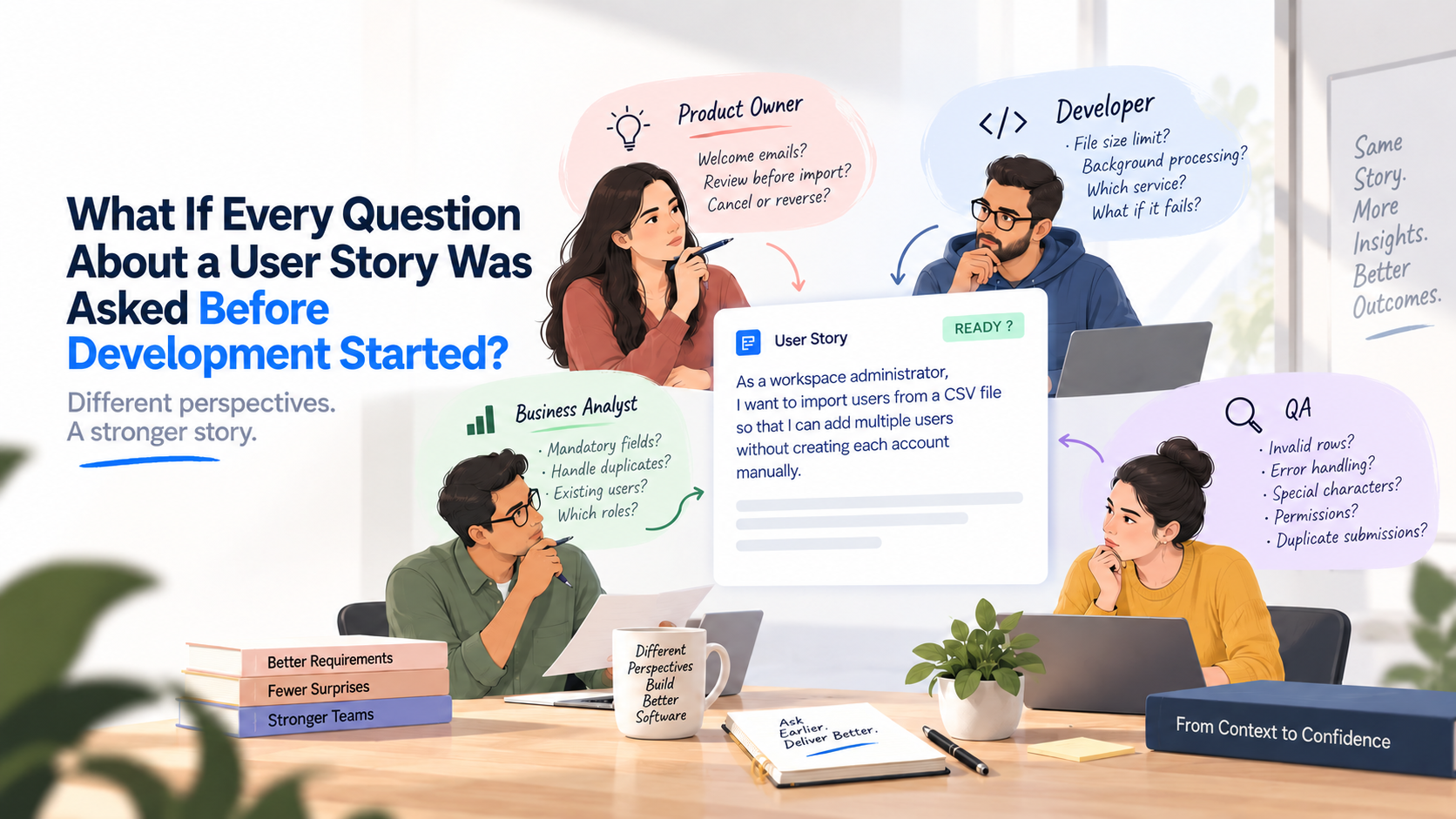
As a workspace administrator, I want to import users from a CSV file so that I can add multiple users without creating each account manually.
The story explains the user, the action, and the expected value. Initial acceptance criteria might state:
- The administrator can upload a CSV file.
- Valid users are added to the workspace.
- The administrator receives a message when the import is complete.
At first glance, that may seem sufficient.
But different team members may see different gaps.
The product owner may ask:
- Should imported users receive welcome emails immediately?
- Can the administrator review the list before accounts are created?
- Can an import be cancelled or reversed?
The business analyst may ask:
- Which fields are mandatory?
- How should duplicate email addresses be handled?
- Can existing users be assigned to the workspace through the import?
- Which roles can be included in the file?
The developer may ask:
- Is there a maximum file size or row limit?
- Should large imports run in the background?
- Which service creates the accounts?
- What happens if processing stops midway?
QA may ask:
- What happens when some rows are valid and others are not?
- How are invalid rows reported?
- Are special characters and different file encodings supported?
- What permissions are required to perform an import?
- Could duplicate submissions create multiple accounts?
The original story was not necessarily poor. It was simply viewed through one lens at a time.
Late Questions Create More Than Delays
A missing answer does not remain a documentation issue once delivery begins.
It may affect:
- The technical design
- The estimated effort
- The user experience
- Error handling
- Data integrity
- Security and permissions
- Test coverage
- Release scope
Suppose the team decides during testing that valid rows should still be processed when other rows fail.
That decision may require changes to the processing logic, results screen, error file, acceptance criteria, and test cases. What could have been a short refinement discussion becomes implementation rework.
This is why early story analysis matters.
The goal is not to eliminate questions. It is to ask the important ones while the team can still respond without undoing completed work.
Bringing Delivery Questions Forward
Before development begins, a story should be examined beyond its title and visible acceptance criteria.
A useful review should consider:
- Whether the intended outcome is observable
- Which business rules apply
- What assumptions remain unconfirmed
- Which roles and permissions are involved
- What happens when the workflow fails
- Which systems or teams are affected
- Whether related defects reveal previous risks
- What meaningful edge cases need a decision
- Whether the likely testing scope can be identified
The answers do not all need to fit inside one long description. Some may belong in acceptance criteria, linked work items, technical notes, test scenarios, or explicit follow-up tasks.
What matters is that important uncertainty becomes visible before the team commits to delivery.
How KontexIQ Supports Earlier Story Analysis
Manually performing a thorough review is possible. Doing it consistently across a large backlog is much harder.
Teams may also review a story without knowing that a related defect, earlier requirement, existing test, or previous delivery decision could change how it should be understood.
KontexIQ helps product, business analysis, engineering, and QA teams examine user stories before development begins.
Using relevant project knowledge from Jira or Azure DevOps, KontexIQ can help identify:
- Ambiguous or incomplete requirements
- Missing acceptance criteria
- Unverified assumptions
- Related dependencies
- Meaningful edge cases
- Areas that require clarification
- Potential testing needs
This does not replace backlog refinement or professional judgment.
It gives the team a stronger starting point for discussion and helps bring questions from later delivery stages into the requirement-review process.
Better Questions Create Better Starting Points
A requirement does not become stronger because nobody questioned it.
It becomes stronger when product, engineering, and QA can examine it from their respective perspectives before implementation begins.
For the CSV import story, early analysis could help the team agree on partial success, duplicate handling, permissions, file limits, notifications, and failure behaviour before those decisions affect code.
The result is not a perfect story.
It is a story with fewer hidden assumptions, clearer boundaries, and a team that shares a more consistent understanding of what needs to be delivered.
Frequently Asked Questions
Why should user stories be analyzed before development?
Early analysis helps teams identify missing decisions, dependencies, assumptions, and edge cases before they affect implementation or testing. This can reduce interruptions and avoidable rework later in delivery.
Does every question need to be answered before development begins?
No. Some technical details can be resolved during implementation. Questions that materially affect expected behaviour, scope, dependencies, risk, or testing should be addressed or assigned before the team commits to the story.
How does KontexIQ analyze user stories?
KontexIQ reviews a story using relevant project knowledge from Jira or Azure DevOps. It helps teams surface ambiguity, missing acceptance criteria, assumptions, dependencies, edge cases, and areas that require clarification.
Ask the Questions Before They Become Rework
Different roles will always see different things in a requirement. The advantage comes from bringing those perspectives together early.
See how KontexIQ helps teams analyze user stories before development begins